
Nikro Air Duct Cleaning in Bluffview: A Homeowner’s Guide
Any company can put a logo on the side of a van. What matters is whether the negative pressure unit that comes through your front door can actually pull the cubic feet per minute (CFM) your duct system requires to carry debris out instead of stirring it around. Nikro equipment shows up in a lot of Bluffview marketing, but the brand name alone tells you nothing. What tells you something is the machine’s rated airflow, how the technician uses it, and whether anyone can explain the setup in plain terms. This guide covers exactly that.
Key Takeaways
- Nikro’s role in a cleaning is mechanical: it creates negative pressure and captures fine particles through HEPA filtration so contamination leaves the system rather than settling into rooms.
- Equipment has to be sized to the home. An undersized unit pulls weak airflow and can leave the ducts dirtier than it found them.
- A Nikro unit sitting in a hallway proves nothing. The suction has to be connected and running during the work.
- For most Bluffview homes, a properly configured portable Nikro unit with HEPA filtration is the right tool for the job.
- Asking a few pointed questions before you book will tell you more than any brochure.
What Does Nikro Equipment Actually Do During a Cleaning?
At the mechanical level, Nikro negative pressure units are designed to do one job well: put the duct system under a steady vacuum while the technician works, so loosened debris travels toward the machine rather than into your living room. The unit pulls air through your ducts, passes it through HEPA filtration, and exhausts cleaner air back out. That filtration stage is the part most people never think about, and it’s the part that matters in a house where someone has allergies.
The sequence a properly equipped crew follows usually looks like this:
- Connect the negative pressure unit to the system at a designed access point.
- Establish steady suction and confirm the airflow is stable before any brushing starts.
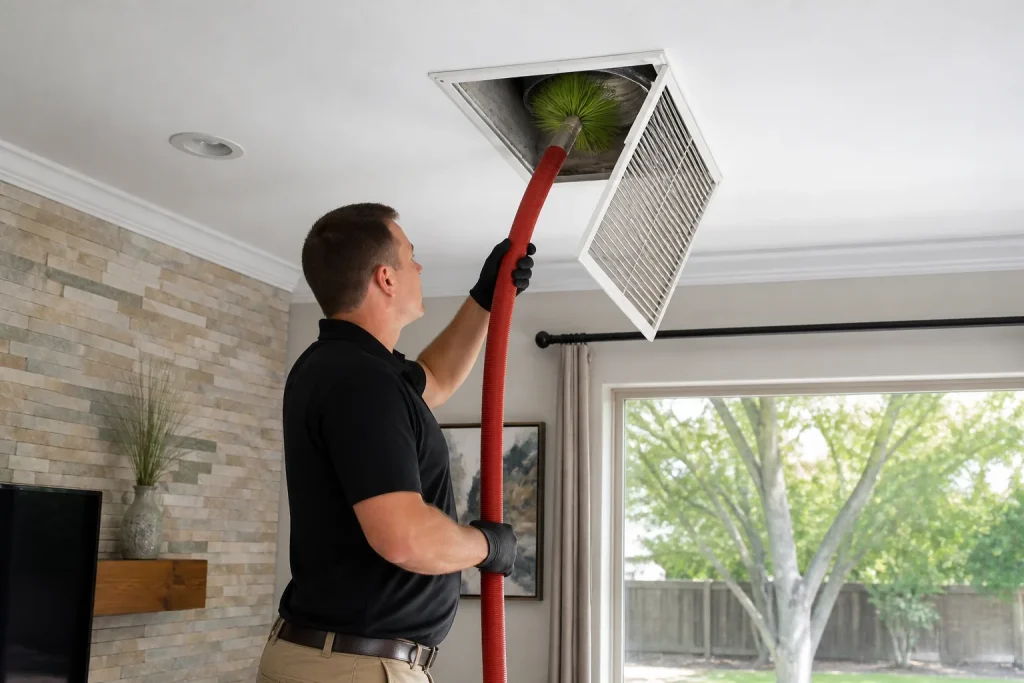
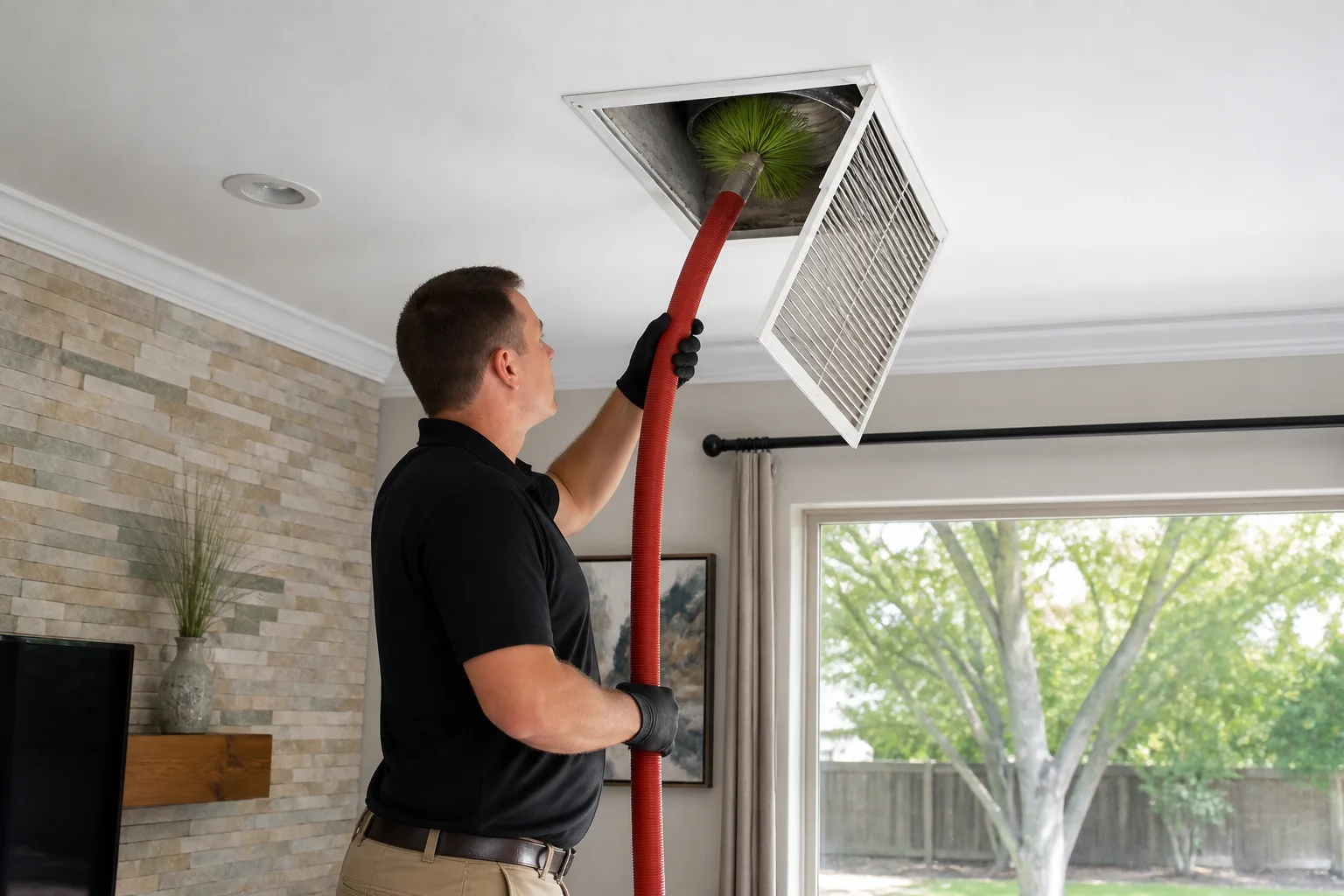
- Use a rotary brush or whip, like those in the Rotobrush line, to agitate debris off duct walls as the vacuum carries it away.
- Work through supply and return runs systematically, not by guesswork.
- Finish with a visual check of the accessible ductwork and the components that came out of it.
Debris that gets loose before suction is established is debris that ends up on your furniture. Airflow first, agitation second. That order matters more than any single piece of equipment.
Why CFM Ratings Matter More Than the Brand on the Housing
CFM, or cubic feet per minute, is the measure of how much air a vacuum unit can move. In a cleaning context, that airflow is what transports loose contamination out of the ducts. Move too little air and the vacuum can’t keep up with the brush. The debris gets knocked loose but never carried away, and some of it settles right back where it was, or worse, drifts into rooms through supply registers.
Bigger, longer duct systems need more airflow than short, compact ones. A modest single-story layout and a sprawling two-story design are not the same job, and treating them as if they were is where undersized equipment shows itself. When a unit is maxed out, the technician works harder, the cleaning takes longer, and results get inconsistent from one room to the next.
- Home size and duct length: more linear feet of duct means more volume to keep moving.
- Duct diameter: larger trunk lines need enough suction to hold airflow at the far ends.
- Number of returns: multiple return runs change how the suction distributes.
- Filter condition: a clogged filter chokes airflow before the machine ever gets a chance.
You don’t need to calculate anything yourself. What you should do is ask whether the equipment was selected for your home or just showed up. In a mix of ranches, two-stories, and older remodels around Bluffview, that question alone separates a thoughtful operator from one running a fixed routine regardless of the house.
Portable Nikro Units vs. Truck-Mount Systems for Bluffview Homes
Truck-mount systems get a lot of attention, and for large or heavily contaminated commercial duct runs they can make sense. For residential work, the conversation is different. A well-chosen portable Nikro unit with HEPA filtration gives you several practical advantages in a home setting.
- Access: no long hose run into the house and fewer limitations on where the unit can sit relative to the ducts.
- Filtration control: the HEPA stage travels with the machine, so fine particles are captured right where the work is happening.
- Noise and footprint: generally easier to manage inside a home than a large external unit.
- Fit to the job: a unit can be matched to the home’s duct volume rather than using the biggest machine available for every call.
The honest answer is that neither setup automatically wins. What wins is correct sizing, correct connection, and a technician who understands both. In our experience, a properly sized portable Nikro unit handles most Bluffview residential jobs without compromise. The equipment brand is a starting point. The setup is what determines the result.
How to Verify Nikro Equipment Is Actually Being Used Correctly
A unit on the driveway or in a hallway doesn’t prove it’s doing anything. Plenty of people have been told the right words while a weak machine sat unconnected. You can check this without any technical background.
- Before work starts: ask to see the unit and ask how it will be connected to the system. A clear answer takes thirty seconds. A vague one tells you what you need to know.
- During the work: the negative pressure unit should be running and connected while brushing and agitation happen. Suction first, brush second.
- Airflow at registers: with the system under vacuum, supply registers should noticeably draw. Weak or absent pull is a sign the unit isn’t keeping up.
- What comes out: a technician should be willing to show you the collection after the job. If they can’t show what was removed, you’re relying on a summary.
- The system, not one room: a full cleaning covers supply and return runs together. Skipping returns leaves a large source untouched.
Improper setup is where undersized equipment fails. So is a machine that gets shuffled room to room without establishing pressure. If a crew can’t explain how the vacuum is configured, the equipment list on their website isn’t doing you any favors.
Questions to Ask a Bluffview Contractor Before Booking
These questions reveal whether a contractor actually understands their own equipment. The answers matter more than the branding.
- What negative pressure unit will be used in my home, and what is its rated airflow?
- How does that unit get connected to my duct system, and at how many access points?
- Does the unit use HEPA filtration, or does exhaust go straight back into the room?
- For a home my size, why is that unit the right fit?
- Will you show me the debris collected and the condition of the accessible ductwork at the end?
- If you find gaps or loose joints, do you repair and seal them, or just note them?
That last question separates a full-system specialist from a single-task cleaner. Cleaning a duct system with leaks is a partial fix because unfiltered air can re-enter the system and bypass the work you just paid for. A contractor who can talk through repair and sealing is thinking about the whole air pathway, not just the inside of the duct walls.
Where the Rest of Your Air Quality System Fits In
Duct cleaning is one link in a chain that includes HVAC coils, returns, and your home’s filtration hardware. A contractor familiar with systems like Honeywell and Aprilaire can tell you when the cleaning alone won’t solve a problem, and when a filtration or humidity component is worth adding. In homes with pets, ongoing remodeling dust, or musty odors, sanitizing treatment after cleaning is often what addresses the source rather than the symptom. Equipment that’s more about consumer uses than whole-house air quality has a place in a garage. It doesn’t belong in your ductwork.
If you want to go deeper on a single service, our pages on air duct cleaning and HVAC cleaning cover the process in detail. When a dryer is venting slowly, that’s a separate but related task, and dryer vent cleaning handles it. If you’re starting from the main overview, Air Duct Cleaning Bluffview lays out the full picture.
When to Call a Pro
You can pull a register cover and take a look with a flashlight. You shouldn’t be climbing into duct runs, connecting vacuum equipment, or trying to clean a system with a shop vac. The danger isn’t dramatic, but a shop vac creates the wrong pressure and moves fine debris into the room instead of out. Leave pressurization and filtration to equipment designed for it. A technician with up to 12 years of experience has run these setups enough times to know what correct airflow looks like.
Call a professional when you notice visible buildup at registers, a persistent musty smell, allergies that worsen indoors, uneven airflow between rooms, or dust returning within days of cleaning. Post-renovation is another common trigger. Call (855) 337-1683. We answer 24/7. Fast dispatch from 7am to 7pm, Sunday through Friday.
The Bottom Line
Nikro equipment matters because of what it does mechanically: negative pressure to keep contamination moving toward the machine and HEPA filtration to capture what gets suspended. Whether it’s used correctly depends on sizing, connection, and a technician who can explain both. Bluffview homeowners who ask those questions get a better cleaning than those who don’t, regardless of who they hire.
If you’re in Bluffview and need help, Air Duct Cleaning Bluffview offers free estimates. We use professional-grade Rotobrush and Nikro equipment on every job, and we cover the full air pathway, including repair and sealing when the cleaning exposes it. Call (855) 337-1683.
Frequently Asked Questions
Yes, by a wide margin. A shop vac can’t generate enough sustained negative pressure across a duct system, and it doesn’t provide HEPA-grade filtration of the exhaust. That means loosened debris ends up in your rooms instead of being captured. Nikro units are built to hold the vacuum and filter the air going back out.
Most Bluffview residential jobs are well served by a properly sized portable Nikro unit with HEPA filtration. Truck-mount systems make more sense for large or heavily contaminated systems. What matters is that the unit’s airflow matches your duct volume, not that it’s the biggest machine available.
Ask to see the unit and how it connects to your system before work starts. During the job, the negative pressure unit should be running and connected while brushing happens. At the end, ask to see the collected debris. A contractor confident in the work will show you.
For most homes, every three to five years is a reasonable baseline. More often if you have pets, recent renovations, or allergy concerns. If you notice musty odors, visible buildup at registers, or dust returning quickly after cleaning, that’s a sign to move up the schedule. Call (855) 337-1683 for an exact assessment. Estimates are free.
Written by the team at Air Duct Cleaning Bluffview.
Need Air Duct Cleaning Help?
Call Air Duct Cleaning Bluffview - the local pro we connect you with is licensed and insured, here with fast help in Bluffview.
(855) 337-1683